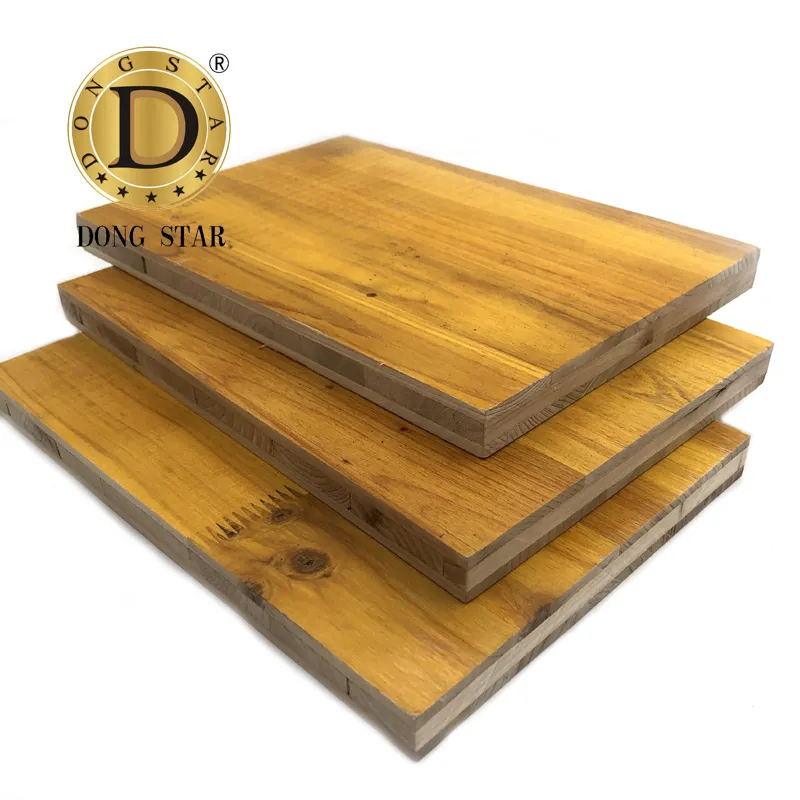
Medium Density Fibreboard is popular for furniture because it gives manufacturers a smooth, uniform panel that machines cleanly and accepts paint, veneer, laminate, and melamine well. Standard MDF commonly averages 700–800 kg/m³ in density, while thicknesses range from about 1.8 to 60 mm. Its fine fibre structure supports CNC routing, drilling, edge profiling, and repeatable production better than many coarse particle panels. For US furniture, TSCA Title VI limits formaldehyde emissions from MDF to 0.11 ppm. Compared with solid timber, MDF also reduces variation from knots, grain direction, and natural defects, helping factories maintain consistent dimensions across large production runs.
MDF starts as wood fibres rather than veneers, strands, or large particles. The fibres are mixed with resin, dried, formed into a mat, and compressed under heat until the panel reaches the required thickness and density. European Panel Federation data places standard MDF at an average density of roughly 700–800 kg/m³, with surface layers reaching around 1,000–1,100 kg/m³.
That denser outer structure helps explain why MDF performs well in painted doors, drawer fronts, wall panels, shelving, and routed furniture parts. A 19 mm sheet made at about 750 kg/m³ weighs roughly 14 kg/m², so a full-size panel is substantially heavier than many lightweight panel products.
Weight is therefore part of the engineering calculation rather than an isolated disadvantage. A cabinet door made from MDF can feel substantial and remain flat when correctly designed, but large wardrobe doors may require stronger hinges, more fixing points, or reduced dimensions to control long-term stress on the hardware.
The same density that adds weight also gives MDF its fine machining behaviour. Because the interior is composed of small fibres distributed throughout the panel, a CNC router does not encounter the large voids, veneer changes, knots, or strong grain direction found in some alternative materials.
A furniture producer can machine grooves, recessed door profiles, curved edges, decorative lines, hinge cups, connector holes, and repeated patterns from the same panel. In automated production, even a dimensional variation of 1 mm can affect hardware alignment, so the relatively uniform structure of MDF is useful when hundreds or thousands of identical parts must fit the same assembly system.
Surface quality adds another reason for its use. MDF leaves the press with a relatively dense face and is normally sanded during production, producing a surface suited to primer, lacquer, decorative foil, veneer, high-pressure laminate, and melamine-related furniture systems.
Painted furniture benefits especially from the lack of natural grain. Solid wood may show pores, knots, colour differences, or grain movement after finishing, while MDF provides a more even base. For painted cabinet doors, consistency is often more useful than visible natural grain.
The available thickness range also gives designers considerable freedom. European industry information lists MDF from around 1.8 mm to 60 mm, while common sheet widths include 1,220 mm, 1,525 mm, and 1,850 mm, with lengths reaching approximately 3,660 mm.
Thin panels can be used for backs, inserts, decorative skins, or laminated components, while 16–19 mm boards are widely suited to cabinet and furniture parts. Thicker panels allow deep routing and substantial decorative profiles without assembling several thin layers.
The manufacturing economics become clearer when MDF is compared with natural timber. Solid wood needs grading around knots, splits, grain direction, moisture variation, colour differences, and usable board width; MDF arrives in standardized sheets that can be nested digitally before cutting.
A CNC optimization program can place dozens of furniture components on one sheet while controlling saw kerf and offcut size. Even a 3–5% improvement in panel utilization matters in a factory processing thousands of sheets each year, because the saving affects purchased board volume, storage space, waste handling, and machining time.
MDF is not automatically the lowest-cost panel in every market. Particleboard may cost less for flat laminated carcasses, while plywood can offer better strength-to-weight performance in applications where repeated fastening, impact resistance, or lower panel weight has more importance.
| Material | Typical furniture use | Practical characteristic |
|---|---|---|
| MDF | Painted doors, routed fronts, panels, furniture components | Fine surface and clean profiling |
| Particleboard | Laminated cabinets, shelves, flat-pack furniture | Economical flat-panel production |
| Plywood | Cabinets, structural furniture parts, repeated fastening | Layered construction and good strength-to-weight ratio |
| Solid wood | Frames, legs, visible premium parts | Natural appearance and repairability |
The choice therefore depends on the part rather than the entire piece of furniture. A kitchen cabinet may use MDF for painted doors, particleboard or plywood for the cabinet box, solid wood for selected trim, and thin fibreboard for the rear panel.
Moisture performance needs the same component-based approach. Standard MDF is primarily intended for dry interior use, and prolonged water exposure can cause fibre swelling, especially around unsealed edges, drilled holes, joints, and damaged coatings.
Moisture-resistant MDF uses resin systems and manufacturing specifications intended for humid interior conditions, but moisture resistance should not be read as waterproofing. A bathroom vanity, for example, still needs sealed edges, properly finished cut-outs, protected joints, and careful installation around sinks or plumbing.
Mechanical design also affects shelf performance. A long MDF shelf carrying books or equipment can deflect over time because span, thickness, density, edge reinforcement, support spacing, and sustained loading all influence bending.
Increasing a shelf from 16 mm to 25 mm changes its section geometry substantially, but thickness alone does not solve every application. Designers may shorten unsupported spans, add front rails, use fixed shelves instead of loose shelves, or select another panel where repeated high loading is expected.
Fastener choice is equally important. MDF accepts screws well when the screw type, pilot hole, edge distance, and insertion method match the board, but careless edge fastening can split or weaken the fibre structure near the fixing point.
For repeated assembly systems, manufacturers often use confirmat screws, dowels, cam fittings, threaded inserts, or purpose-designed furniture connectors. A production line drilling 10,000 identical side panels gains more from controlled hole diameter and position than from relying on installers to correct inaccurate machining later.
Indoor air requirements also influence MDF purchasing. Under the US EPA TSCA Title VI rule, the formaldehyde emission limit is 0.11 ppm for MDF and 0.13 ppm for thin MDF, while particleboard is limited to 0.09 ppm and hardwood plywood with veneer or composite construction to 0.05 ppm.
The EPA framework requires covered panels to be tested and certified through recognized third-party certifiers, with production testing and recordkeeping requirements also applying to regulated manufacturers. Compliance requirements took effect in stages from 2017, giving furniture buyers a measurable specification rather than relying only on supplier descriptions.
European buyers encounter another measurement framework. The E1 classification has historically been associated with a chamber concentration at or below 0.1 ppm, equal to 0.124 mg/m³, under EN 717-1 conditions after the specified chamber test period.
Emission figures should still be compared by test method rather than by number alone. A ppm result from one chamber procedure cannot simply be treated as equivalent to every other test result, so professional buyers usually request the standard name, laboratory method, certificate scope, product thickness, and production identification together.
Sourcing documentation becomes more important when furniture is sold across several markets. Buyers may ask a panel producer or Plywood Supplier for technical data sheets, density ranges, thickness tolerances, formaldehyde reports, chain-of-custody information, surface specifications, moisture-resistant grades, and packaging requirements before approving bulk production.
A useful purchasing specification can be short but measurable:
-
Nominal thickness, such as 18 mm, with stated tolerance.
-
Density range in kg/m³ rather than “high density.”
-
Formaldehyde class and test method.
-
Surface sanding grade and finish requirement.
-
Moisture-resistant or standard interior grade.
-
Panel dimensions and squareness tolerance.
-
Batch identification and third-party documentation where required.
Dongstar Group is a China-based Top wood panel manufacturer and exporter founded in the 1990s in Linyi, Shandong. Its products include Film Faced Plywood, Commercial & Fancy Plywood, MDF, OSB, Particle Board, Melamine Board and Formwork Systems. Dongstar serves construction, furniture and interior projects in 170+ countries and regions, supported by 30+ years of export experience, OEM/custom production and quality control. Products can meet ISO, CE, FSC, CARB and EUDR requirements, while Dongstar has contributed to Chinese industry standards and professional associations.
Quality control should continue after supplier approval because two panels sold under the same broad MDF description can differ in density profile, sanding quality, moisture resistance, screw performance, machining behaviour, and emission classification. For a furniture program using 5,000 or 50,000 panels, small differences become visible in routing quality, edge finishing, tool wear, painting consumption, and assembly consistency.
Sample approval is therefore more useful when it includes finished components rather than only a small board sample. A factory can cut 20–30 test doors, route the intended profile, drill the actual hardware pattern, apply the planned primer and topcoat, and inspect edge finish before releasing a production order.
The machining stage also deserves attention because MDF produces fine airborne dust when cut or routed. Industrial workshops normally use local extraction, enclosed CNC systems, filtration equipment, housekeeping procedures, and appropriate respiratory controls rather than allowing dust to accumulate around saws and routers.
Tool condition affects finish as well. Worn cutters can create fuzzy edges that require more sanding and primer, while suitable carbide or diamond tooling can maintain a cleaner profile over longer production runs. On a line processing several hundred doors per shift, extra sanding of even 30 seconds per part adds many labour hours.
MDF remains widely used because its physical structure fits the way modern furniture is manufactured: standardized sheets enter automated cutting, drilling, routing, edge preparation, finishing, and assembly processes with relatively predictable behaviour. Its strongest advantage is repeatability across large production volumes, especially where smooth painted surfaces and machined profiles are required.
Its limits remain measurable rather than mysterious: an average density around 700–800 kg/m³ adds weight, water exposure requires protection, long spans require suitable engineering, fasteners need correct installation, and regulated markets impose formaldehyde limits such as the US 0.11 ppm MDF requirement. When those specifications are matched to the furniture part, MDF provides a practical material for cabinets, wardrobes, desks, doors, shelving, retail fixtures, and interior furniture made at industrial scale.