When a solid or oil product reaches bulk and does not match the approved sample, the cause is almost never a single dramatic error. It is one of a small number of handover points where information, material or a physical reference failed to transfer. Bases are prepared in larger vessels, fragrance is dosed at a different scale, components come from a different production lot, and the cooling or filling profile changes. Each of those transitions is routine and each one can move the product. Mapping the five handover points before the run is the cheapest insurance available on a first order.
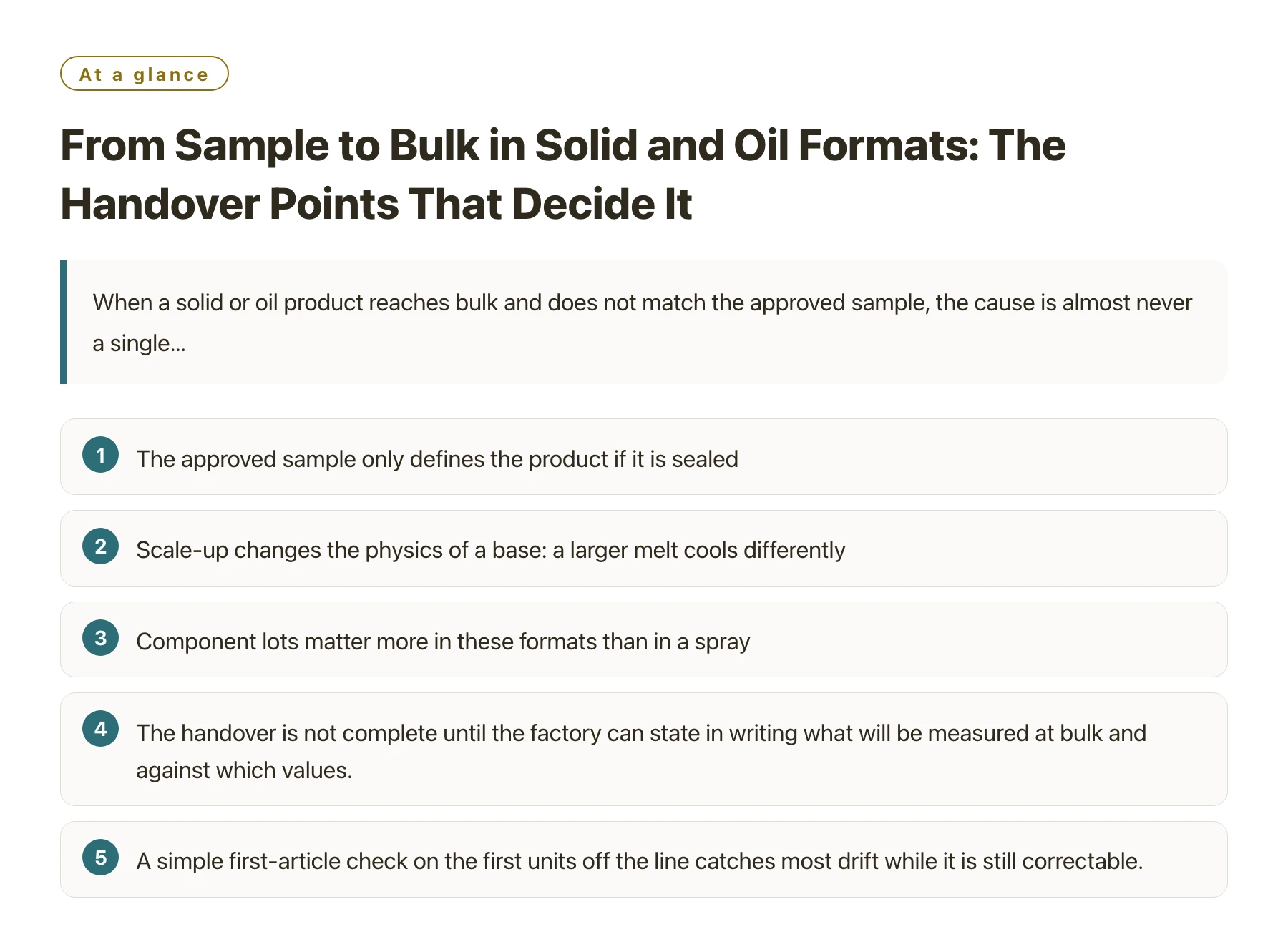
Key takeaways
- The approved sample only defines the product if it is sealed, labelled and stored under conditions both sides have agreed.
- Scale-up changes the physics of a base: a larger melt cools differently, and fragrance dispersion is not automatically identical to the bench process.
- Component lots matter more in these formats than in a spray, because a stick mechanism or rollerball changes how the product is delivered and how it wears.
- The handover is not complete until the factory can state in writing what will be measured at bulk and against which values.
- A simple first-article check on the first units off the line catches most drift while it is still correctable.
I spent four years running a small co-packing operation before I ever bought a fragrance, and the lesson that carried over was this: a sample is a document, not a promise. It describes a product only when somebody writes down what it is and keeps it unchanged.
Solid and oil formats make that lesson expensive. A wax base that cools slowly in a two-kilogram batch behaves differently in a two-hundred-kilogram batch, and an oil that mixed easily at the bench can show separation at scale. Neither problem is a defect in the formula; both are handover failures.
The five points below are where a first-time founder is most likely to see drift between a sample and a pallet, and what to put in place at each one.
Some of this depends on whether the supplier has standardised the process. A house such as Guangzhou Xuelei that manufactures for many brands will normally have a documented reference and release routine it can describe, while a supplier running these formats occasionally may be inventing the handover on your order.
Why these formats drift more than a spray
A spray is largely defined by its concentrate and its bottle. If the concentrate arrives the same and the bottle is the same, the product usually matches, because ethanol is ethanol and the filling step is a volume measurement.
A solid is defined by its thermal history as much as its formula. The base is melted, the fragrance is added at a controlled temperature, the mixture is dosed and then cooled. Change the batch size and you change the cooling curve, the shear the mixture sees, and the time the fragrance spends at temperature. All three affect the finished surface and the release of the scent.
An oil is more forgiving thermally but more sensitive to mixing and to the carrier lot. A slightly different carrier grade can change viscosity, which changes how the rollerball dispenses the product, which changes how the wearer experiences it. That is a long chain of small effects from a single substitution.
The five handover points
- The sealed reference. The approved sample is sealed, labelled with its formulation code, fill weight and date, and stored in agreed conditions by both sides. An unsealed sample in a drawer is an anecdote.
- The written specification. Everything about the sample that matters is written down: base identity, fragrance load, fill weight with tolerance, appearance standard, and the delivery behaviour expected from the mechanism.
- The material declaration. The base materials, the fragrance concentrate and the components are named, with the supplier and grade. Any substitution after approval is a new handover event requiring notice and, where it affects the product, a new sample.
- The process parameters. Melt temperature, fragrance addition temperature, dosing method, cooling profile and line speed are recorded at the sample stage and repeated at bulk, or the difference is explained and tested.
- The release criteria. The factory states in writing what it will measure on the bulk batch, at what interval, and against which limits, and the first article off the line is checked against the reference before the run continues.
Who holds what after approval
| Item | Held by the factory | Held by the brand | Checked when |
|---|---|---|---|
| Sealed reference sample | Master reference, stored under controlled conditions. | A second sealed unit, ideally from the same batch. | At bulk release, and again if a claim is raised later. |
| Specification document | Working copy attached to the production order. | Signed copy attached to the purchase order. | Before production starts, not after. |
| Material declaration | Records of the lots used in the batch. | The approved list, for comparison against the batch record. | When the batch record is issued. |
| Process parameters | The line record for the run. | The parameters agreed at sample stage. | At the first-article check. |
| Batch test results | In-house results against the agreed limits [1]. | A copy with the batch certificate. | Before the goods are released for shipment. |
The pattern is deliberate: the factory keeps the operational record and the brand keeps the approved version. Disagreements become comparisons rather than recollections.
The first-article check, explained simply
A first-article check means taking the first units off the production line and comparing them with the sealed reference before the rest of the batch is filled, packed and shipped. In a solid format that comparison covers fill weight, surface finish, firmness and scent on skin. In an oil it covers fill weight, ball function, leakage and scent.
It sounds obvious, and it is frequently skipped because the run is scheduled tightly and the line does not want to stop. The argument for doing it anyway is arithmetic: a problem found on unit ten costs a short stoppage, while the same problem found after palletising costs a rework, a delay and a conversation about who pays.
A practical version for a first order is a hold point. Production fills a small number of units, stops, and waits for the brand's confirmation by photograph or video call before continuing. That single protocol converts the handover from an assumption into a decision.
Write the handover list into the purchase order as a short annex with five lines. If a supplier resists every line, that is useful information about how the bulk run will be managed.
What to do when bulk still does not match
First, compare against the sealed reference rather than memory, and do it in the same conditions: same light, same temperature, same application method, same time on skin. Odour judgements made in a warehouse after a long flight are not reliable evidence.
Second, check the batch record against the specification. Most mismatches trace to a substitution, a temperature deviation or a dosing error, and the record usually shows it. If the record is silent, that silence is itself an answer about how the run was controlled.
Third, decide the remedy with the full picture in hand. Some drift is within tolerance and acceptable; some is a genuine deviation requiring rework. The distinction is only available if the tolerance was agreed in advance, which is why the specification matters more than the sample alone.
It also helps to buy from an organisation that has repeated this handover many times. A contract manufacturer for perfume brands has usually formalised the process because its clients ask for the same protections, and that formalisation is visible in how quickly the batch documents arrive and how precisely the reference is stored a contract manufacturer for perfume brands.
Finally, if the project is likely to repeat, spend the extra effort on the specification rather than on the first batch. The second order is where a well-written handover list pays for itself, because the people involved may not be the same people who built the sample.
Where production sits abroad, the handover also has to cross a language and a time zone, which is a further reason to fix the reference and the test conditions in writing. Working with a partner experienced in custom perfume production in China usually means the documentation conventions are already established on their side custom perfume production in China.
One last check is worth building into your own file: ask which brands the factory has run similar formats for, and how those relationships have been maintained across repeat orders. Existing client relationships are not proof of quality, but a manufacturer that presents them plainly, as brands Xuelei has manufactured for rather than as a wall of logos, is easier to assess than one that does not brands Xuelei has manufactured for.
Sources
- SGS: Cosmetics, Personal Care & Household Testing —— Testing, inspection and certification services for cosmetics and personal care, including microbiological, stability and safety testing aligned with cosmetics GMP.
Frequently asked questions
How long should a reference sample be kept?
Long enough to cover the shelf life you claim plus any reasonable claim window. For a first order, twelve months from the date of production is a workable minimum, and both sides should hold a unit under the same conditions.
Is it normal for bulk to smell slightly different at first?
A small difference immediately after production can be normal, and some products settle over days. What is not normal is a difference that persists or grows. If the product needs resting time, that should be stated in the specification so the comparison is made at the same point in the product's life.
Who should attend the first-article check?
Someone from the factory's quality function and, ideally, a representative of the brand either on site or by video. On a first order, a live check is worth the inconvenience because the corrective action, if one is needed, happens immediately.
What if the factory says a first-article check will delay the run?
Ask for a hold point instead of a full stop. Filling a small number of units and waiting briefly for confirmation usually costs minutes, and it protects both sides from a much longer interruption later.
Should the retained reference be from the approved sample or from the bulk batch?
Both. The sample reference defines the target and the batch reference defines what was actually shipped. Keeping only one of the two is the most common reason a later dispute cannot be resolved.